



MT 180 2026: the jury and audience have chosen the winners of the IP Paris
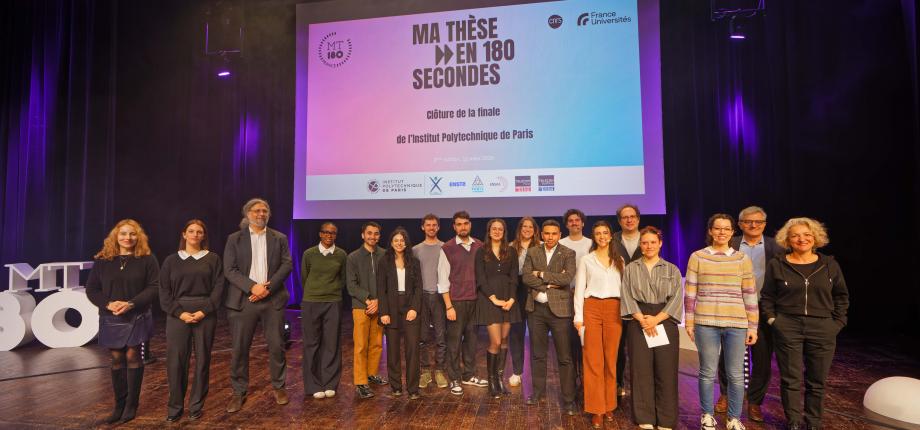
The competition was intense and close on Thursday, March 12, 2026, on the stage of the Poincaré amphitheater at Ecole Polytechnique. The IP Paris finalists in the local final of the MT 180 competition brilliantly presented their thesis topics to an audience of non-science experts who were captivated by their presentations. Among the people in attendance, 200 high school students were invited by the IP Paris Equal Opportunity Center as part of the national Cordées de la Réussite program.
The My Thesis in 180 Seconds competition is an original way to present research and encourage young people to pursue a career in science. After the presentation, the high school students had lunch with the finalists to talk with them and learn more about careers in research.
2026 Winners
The jury, composed of prominent figures from the academic, scientific, artistic, media, and educational worlds, had a difficult task in deciding between the candidates' presentations. Thanks to their complementary perspectives, they recognized the clarity, pedagogy, and scientific passion of the doctoral students.
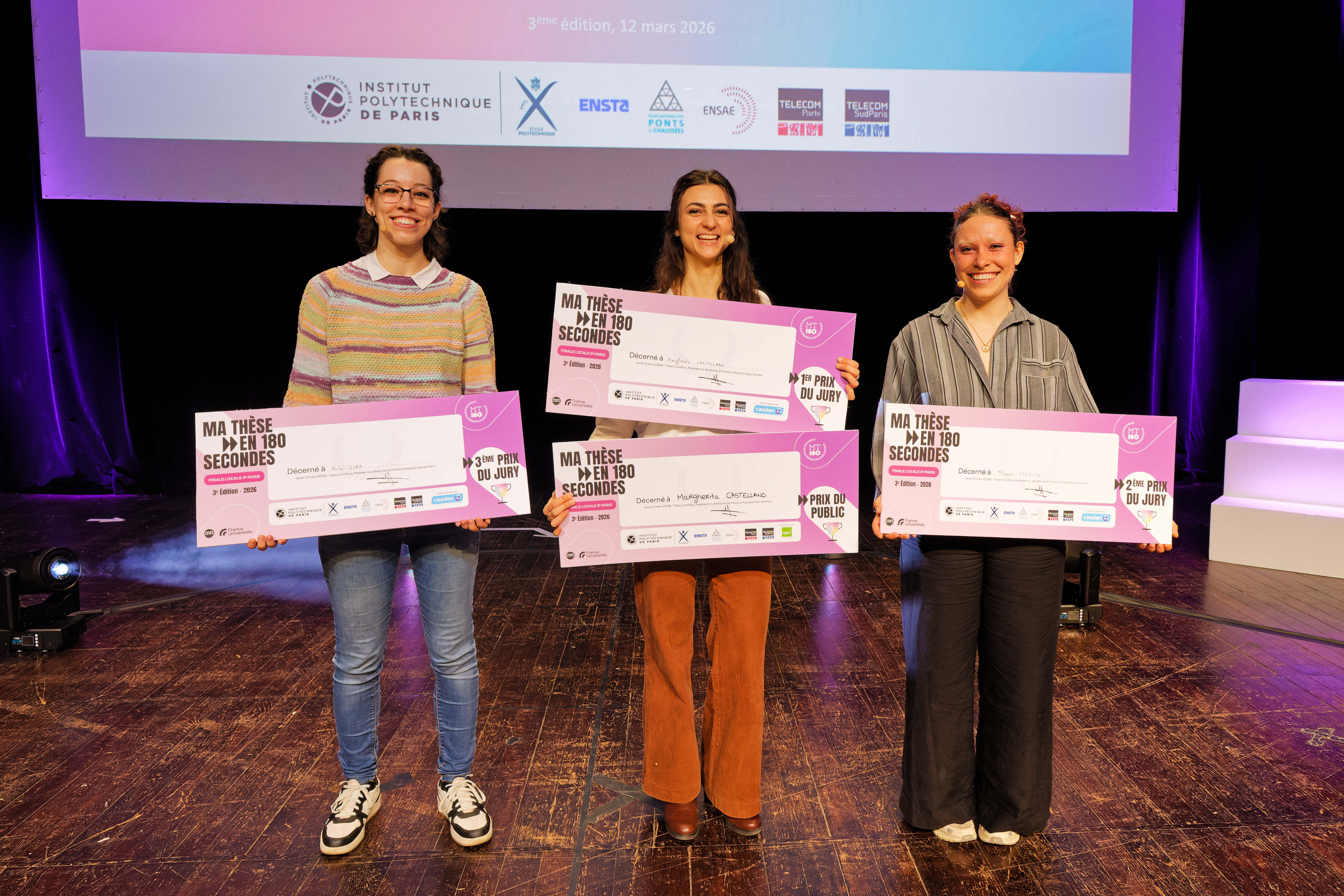
Here are the winners for the 2026 edition:
- The jury’s first prize was awarded by Matthieu Lefrançois, physics editor for Sciences & Vie Junior magazine, to Margherita Castellano, doctoral student at the Center for Applied Mathematics (CMAP*), for her thesis entitled Navier-Stokes-Cahn-Hilliard Equations with Surfactants.
- The jury's second prize was awarded by Étienne Brière, Scientific Director and Partnerships Director for France & Expert Fellow at the EDF Group, to Magali Korolev, doctoral student at the Center for Theoretical Physics (CPHT**), for her thesis entitled Correlated Systems in Interaction, Transport in Mesoscopic Physics, and Quantum Information.
- The jury's third prize was awarded by Sylvie David, actress and performer, to Kate Sorg, doctoral student at the Optics and Biosciences Laboratory (LOB***), for her thesis entitled Biological functions of non-canonical nucleic acid structures called G-quadruplexes in archaea.
- The audience award was presented by Kellya Manange, a senior at the Lycée Julie Victoire Daubié in Argenteuil, to Margherita Castellano, doctoral student at the Center for Applied Mathematics (CMAP*), for her thesis entitled Navier-Stokes-Cahn-Hilliard Equations with Surfactants.
A big congratulations to all three of them. They will take part in the regional final of the MT 180 competition, which will take place on April 16, 2026, at La Terrasse in Gif-sur-Yvette.
 | Margherita Castellano is writing her thesis at the Center for Applied Mathematics (CMAP - a joint research unit CNRS, Inria, École Polytechnique, Institut Polytechnique de Paris, 91120 Palaiseau, France). It is entitled Mathematical modeling of the separation of two immiscible fluids in the presence of a species called a surfactant. What does your thesis work involve and what are its possible applications?My work consists of mathematically describing a physical situation in order to better understand the dynamics at play. In this case, I am interested in the interaction of two fluids that do not mix—such as water and air or water and oil, for example—in the presence of small molecules called surfactants. These molecules have the property of altering surface tensions and stabilizing systems that would otherwise separate rapidly (kinetically unstable). During my thesis, I carried out modeling work in order to choose the right equations and terms to describe the temporal evolution of the physical phenomenon observed. However, as these equations are too complex to be solved exactly using mathematical formulas, I used a numerical method to obtain an estimate. I then mathematically analyzed the properties of the resulting system of equations (called a discrete system) to verify the reliability of the results it provides. I was then able to numerically simulate the physical phenomenon and better understand it. Surfactants are extremely common and are used in a wide variety of contexts. A better understanding of how they work can therefore be useful in many fields, such as climate science, the pharmaceutical industry, and microfluidics. What does the MT180 competition mean to you and what do you expect from this experience?In my opinion, the MT180 competition is above all a challenge to popularize science. It allows me to share complex research issues and abstract concepts in a few words while trying to convey my fascination with mathematics. I also find it very interesting, even powerful, to be limited to three minutes. It forces you to eliminate the superfluous. Finally, I hope to bring my thesis to life through this experience by making it vivid and meaningful. I really enjoyed searching for metaphors while writing my text, and I intend to enjoy it even more during the competition. leur donnant de la voix. |
 | Magali Korolev is writing her thesis at the Center for Theoretical Physics (CPHT—a joint research unit CNRS, École Polytechnique, Institut Polytechnique de Paris, 91120 Palaiseau, France). It is entitled Electrons as Bic pens: understanding how simple quantum building blocks can construct everything. What does your thesis work involve and what are its potential applications?My thesis work is theoretical and concerns both quantum physics and condensed matter physics. I am interested in topological systems, i.e., materials in which large numbers of electrons organize themselves and interact with each other to generate stable collective properties that are resistant to perturbations. Depending on the arrangement of electrons and their interactions, these systems undergo phase changes (or changes in state, similar to how water exists in solid, liquid, or gaseous form). They can then transition from a very simple phase—for example, an insulating state in which electrons are immobile and do not interact with each other—to a topological state. This is the topological phase transition. Using equations and numerical simulations, I characterize these transitions in systems where electrons interact and move according to precise rules and geometries. I then observe how these same rules and geometric structures affect topological transitions. In this context, it turns out that the transition from a simple state to a topological state results in equations that are completely different from those that would characterize a transition between two simple states. But why study these phase changes? Certain materials that behave like topological systems often exhibit electronic excitations at their edges: protected edge states. These are immune to any impurities, changes in parameters, or inevitable particle agitation (quantum fluctuations), which is of great interest to quantum computer designers. For several years now, scientists have been working to develop quantum chips that use protected edge states to generate qubits (the unit of information in quantum computing). The resulting computers will be powerful and reliable. However, manipulating these particles and their properties requires a very good theoretical knowledge of quantum materials, about which there is still much to discover. Hence my thesis work. What does the MT180 competition mean to you and what do you expect from this experience?In addition to popularizing science, this competition is above all an ideal opportunity to promote science and research, particularly among young girls. I chose science because when I was younger, I was lucky enough to see many documentaries and popular science videos on the web. They were all made by very talented people who sparked my interest, but few of them were women. Today, I am a doctoral student—something I have always dreamed of—and I feel that it is now my role to pass on my passion for quantum physics and science in general, especially to girls! |
 | Kate Sorg is conducting her thesis at the Laboratory of Optics and Biosciences (LOB — a joint research unit CNRS, Inserm, École Polytechnique, Institut Polytechnique de Paris, 91120 Palaiseau, France). It is entitled Biological functions of non-canonical nucleic acid structures called G-quadruplexes in archaea. What does your thesis work involve and what are its potential applications?The DNA molecule is known for its double helix structure and its adenosine-thymine (A-T) / guanine-cytosine (G-C) bonds. However, this universal assembly pattern can sometimes differ, with guanine nucleotides binding together to form quartets. These then spontaneously stack on top of each other and give rise to somewhat strange DNA structures called G-quadruplexes (G4). G4s influence the way our DNA functions. They can impact genome expression and replication and are capable of turning cellular processes on and off for their maintenance. My work therefore involves specifically studying G4s in archaea, microorganisms that are evolutionarily close to eukaryotes and live in conditions that are not conducive to life: high temperatures (95°C), acidic environments, saline environments, etc. I first used immunofluorescence microscopy to mark and precisely locate G4s. Using microscopes with increasingly high resolution (around 20 nm for some), I was able to show for the first time that G4s exist in these microorganisms, which constitute an ancient group of life on Earth. Observing G-quadruplexes in archaea also proves that these structures were present very early in evolution and are therefore present in all living beings today. With this first step completed, I am now seeking to understand the different roles of G4s within archaea. I plan to remove certain G-quadruplexes to see if archaea can still survive in extreme conditions. The next step will be to determine whether the roles of G4s are similar in archaea and humans, and thus discover any links between these two groups. Or, conversely, to identify functions specific to archaea. This fundamental research will pave the way for further research into the potential applications of G4s. These include the use of these structures in the development of drugs to treat neurodegenerative diseases. What does the MT180 competition mean to you and what do you expect from this experience?I am originally from the United States and have been living in France for three years. This competition is a way for me to test my French, but also to take pride in all the work I have accomplished scientifically, linguistically, and culturally. MT 180 will also allow me to learn how to communicate my research to the general public and discover the work of other competitors...all while having fun! |
Institut Polytechnique de Paris warmly thanks its partners — Ville de Palaiseau, Science et Vie, CASDEN Banque Populaire, MGEN — for supporting the prizes of the 2026 edition.
Our thanks also go to the members of the jury — Jamal Atif, Etienne Brière, Audrey Sedano, Matthieu Lefrançois, Sylvie David, Amélie Kies and Kellya Manyange — for their keen insight.
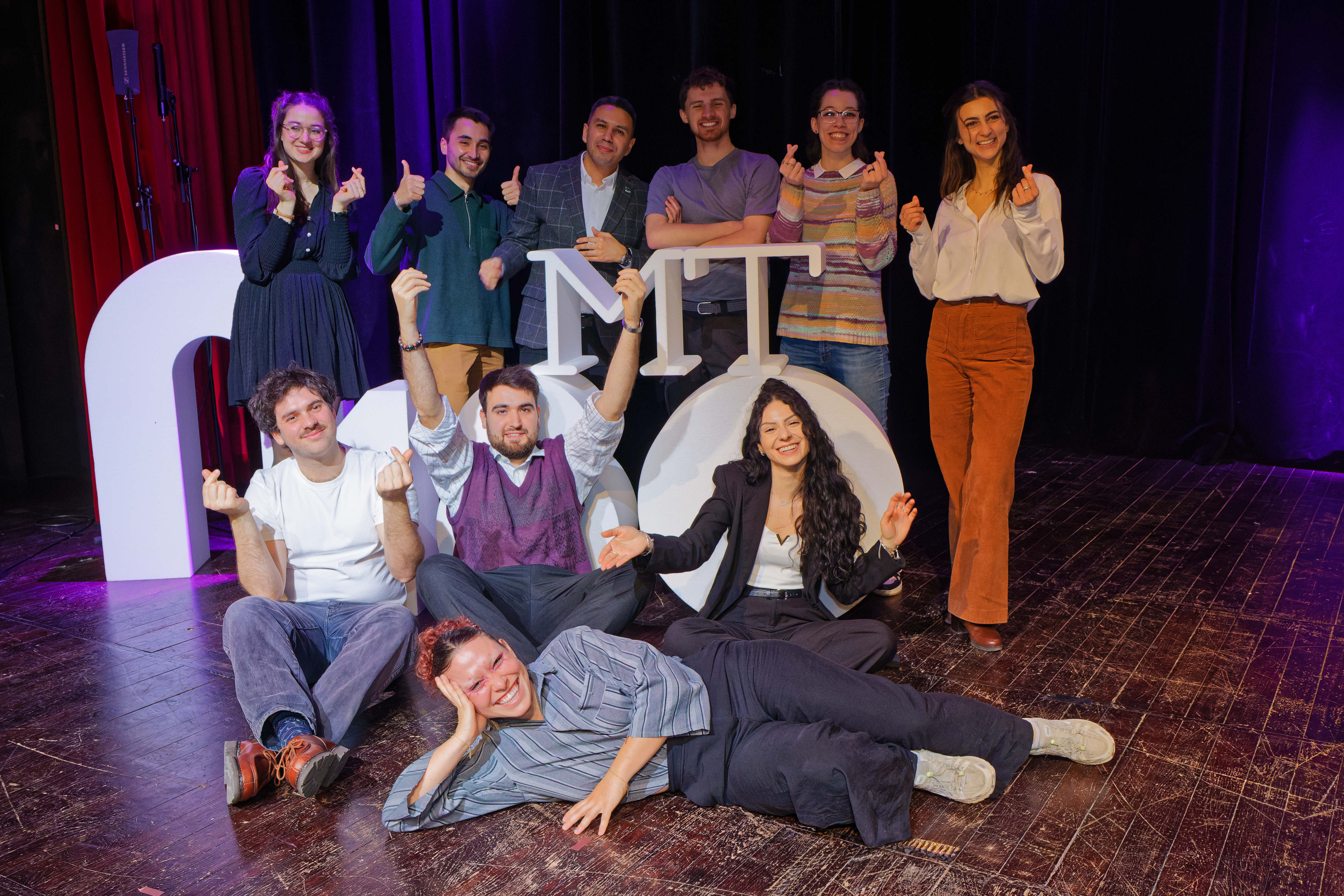
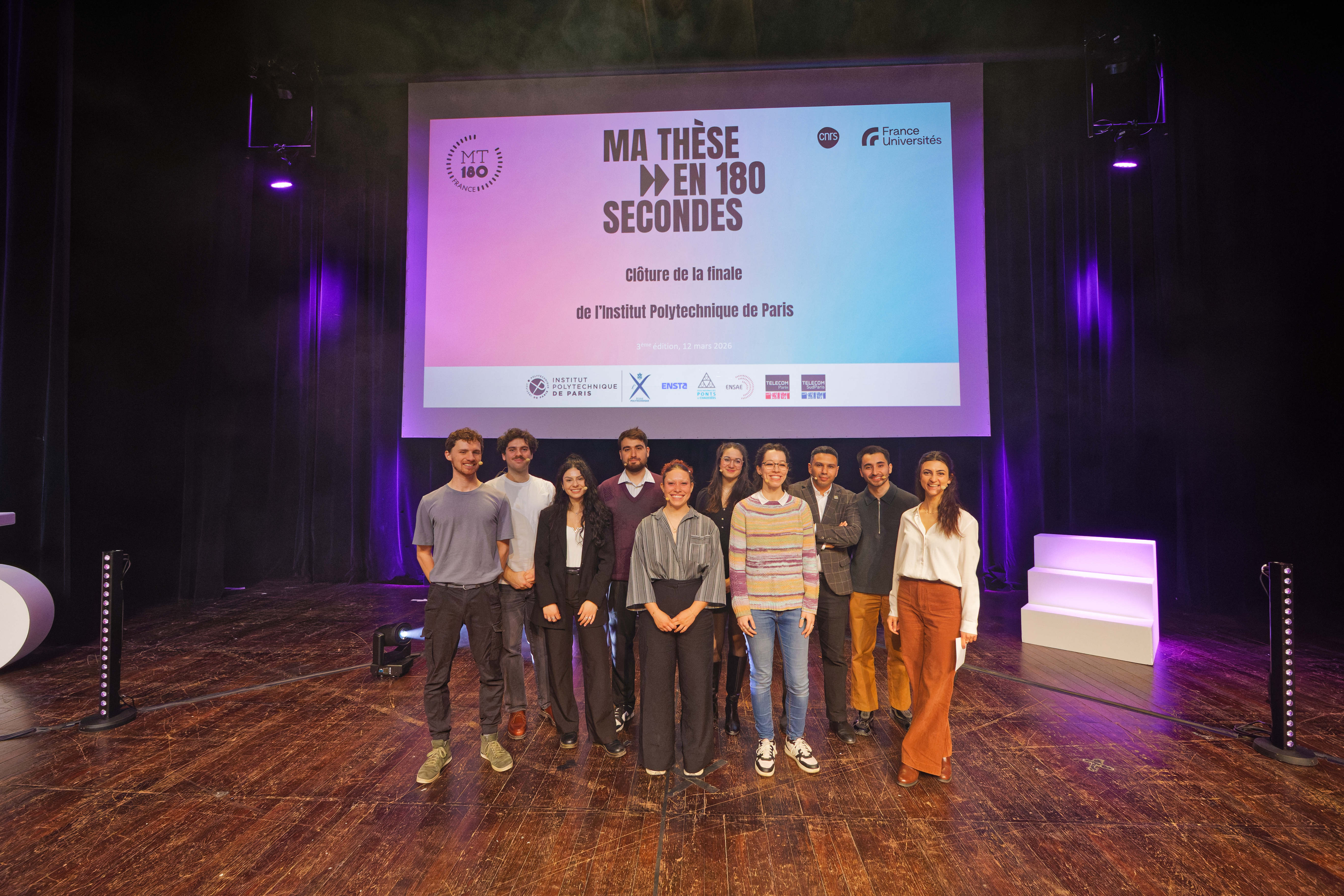
Finally, congratulations to Augustin Cledat, Umberto Fontana, Louise Loridon, Martina Pierri, Adrien Ramanana Rahary, Nathan Roubinowitz, and Nadir Soucha for their eloquence and courage!
*CMAP: a joint research unit CNRS, Inria, École Polytechnique, Institut Polytechnique de Paris, 91120 Palaiseau, France
**CPHT: a joint research unit CNRS, École Polytechnique, Institut Polytechnique de Paris, 91120 Palaiseau, France
***LOB: a joint research unit CNRS, Inserm, École Polytechnique, Institut Polytechnique de Paris, 91120 Palaiseau, France
Header photo: from left to right — Sylvie David, Audrey Sedano, Jama Atif, Kellya Manyange, Adrien Ramanana Rahary, Martina Pierri, Nathan Roubinowitz, Umberto Fontana, Louise Loridon, Amelie Kies, Nadir Soucha, Augustin Cledat, Margherita Castellano, Matthieu Lefrançois, Magali Korolev, Kate Sorg, Etienne Brière, Valérie Druguet.